Blog Posts

Happy Valentine’s Day

I know Valentine’s day is February 14 but since Saturdays are the worst days to post a blog, I thought I would post it today. Granted, I don’t know if it matters or not… it’s not like I have a large readership.

Valentine’s Day and I Go Way Back

Valentine’s Day and I go way back. For years, I bought into the hype—chocolates, cards, flowers, stuffed animals, the whole nine yards. I still buy those things… just not on Valentine’s Day anymore. Amy may actually prefer it that way. At least that’s what I keep telling myself.

One year, I snapped a picture of some flowers and sent it to Amy with the message: “These flowers will die, but this picture will last forever.”

She replied with a picture of a T-bone steak:
“This steak will be gone in five minutes, but this picture will last forever. Happy Valentine’s Day.”

It only took her ten years, but she’s finally catching on to my humor.

Side note: February 14, 2005 (Valentine’s Day), I proposed. I did it then because it was the last thing she’d expect. I usually go for something more… creative.

Our very first Valentine’s Day, I bought a giant box of Britney Spears Valentine cards. I signed every single one and gave them all to her. She was thrilled.

A year later, I told her to wear the fancy silk dress that I bought her on a trip to China — and the look on her face said she was expecting the date of a lifetime. She was sure we were heading to some upscale restaurant.
We were not.

I took her to Mandarin Express on 23rd and Rockwell — and the confused look on her face was absolutely priceless. A magnificent Chinese dinner for under $7! And since it was opening night of Shanghai Knights at Quail Springs Mall… well, how could I pass that up? It’s one of the few times in our relationship when I don’t think Amy was very impressed with me. She hasn’t worn that dress since.

I’m pretty sure the next year I proposed.

Our first Valentine’s Day as husband and wife, she got a dozen roses. She was ecstatic. Two years later she learned a vital detail: the flowers were actually intended for the receptionist. they were originally delivered to the office for the receptionist by her boyfriend. When the receptionist left for the day, I took them home for Amy. When Amy saw me bring them back to the office the next morning, I told her I wanted everyone to see the “nice flowers she received.” I did this for several days until the roses died.

Another year— I bought a huge box of chocolates, wrote a heartfelt mushy card… and secretly replaced every piece of chocolate with carrots and celery. I learned later that this was not, in fact, funny.

My Valentine’s Day antics used to irritate Amy. But eventually she realized: this is a family tradition. My dad did the same thing for my mom. One year he gave her twelve sandwich bags full of flour arranged in a vase. A fourth-grader thought she’d received crack. Another year he gave her an actual cow heart.

Now, when I do things like that — carrying on the same Valentine mischief my dad perfected — Amy knows it’s because I love her. And I like to think I am setting a great example of spoiling and loving my wife for my boys to experience and repeat for their own wives one day. 

Ok… enough randomness for today. Happy Valentine’s Day.
A Song for Sugar Booger

(A very clean parody inspired by Song of Solomon)

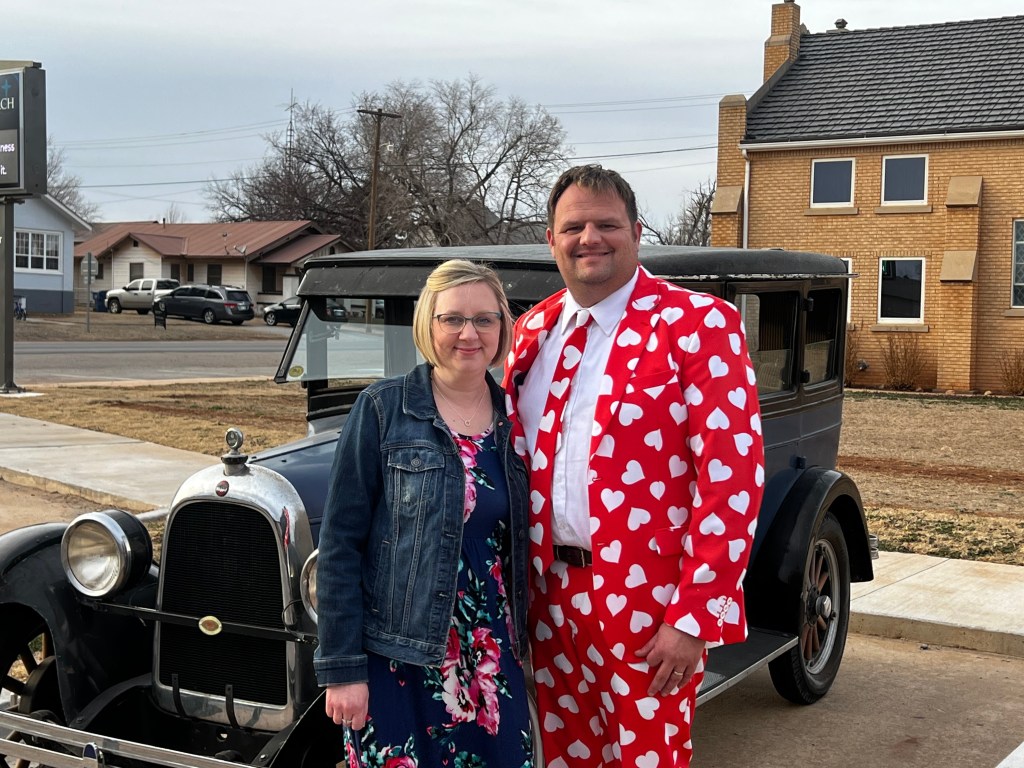
I’ve never been subtle about my admiration for my wife, and I don’t plan to start now. I’ve watched Amy care for people quietly, consistently, and without drawing attention to herself. I’ve also heard many others say what I’ve thought for a long time—she deserves Okeene Citizen of the Year.

She’s cared for people at their best, their worst, and—on occasion—when they probably wished she wasn’t there at all. She does this work with skill, compassion, and humility, all while loving our boys well and being married to me, which many have assured me is no small act of service.

So this isn’t a serious theological exercise, and it’s definitely not Scripture. But it is a lighthearted, very clean, slightly tongue-in-cheek love letter written in the style of Song of Solomon—because if Solomon could write poetry about his beloved, I can at least attempt a parody for Sugar Booger.


The Song of Sugar Booger

(The Book of Mike, Chapter 1)

1. Behold, how wonderful you are, my beloved,
how steady and wise beyond measure.
You are known in the town for your care and patience,
while I am mostly known
for colorful shoes and sarcasm.

2. Your short hair is confidence itself—
ready for the day,
unbothered by the wind,
and far more practical
than anything Solomon ever described.

3. Your hands bring calm to anxious hearts
and reassurance to worried minds.
You speak comfort with wisdom
and compassion with clarity,
and still return home
with grace left to spare.

4. Your voice is gentle yet firm.
You have said,
“Mike, no,”
and I have learned
this is both loving and correct.

5. Your patience is well known.
Many have called you a saint,
a hero,
and the most patient person they know—
largely because you are married to me.
I find no fault in their assessment.

6. You keep our household running smoothly.
You remember appointments.
I ask what we’re already late for.
You maintain the budget.
I ask, “How bad would it be if I bought this?”
You bring order.
I keep things… interesting.

7. Your laughter fills our home with joy.
It lightens long days
and steadies heavy moments.
It reminds me that love is not loud,
but faithful.

8. Many waters cannot quench your grace,
nor can floods drown your kindness—
not even the weekly rising of the laundry,
which multiplies without explanation.

9. I am my beloved’s, and my beloved is mine—
for many years and counting.
Together we walk forward,
raising boys,
serving others,
and trusting the Lord
who knew exactly what He was doing
when He placed us together.


I will continue to say it plainly: Sugar Booger, you are a gift—to our family, to this town, and to me.

Things Lunch Ladies Take Personally

In a previous blog, I mentioned that I went four years without paying for a school lunch. I also shared that when the change I’d collected wasn’t enough for the snack bar, my backup plan was the actual school lunch—already paid for by my parents.

That’s where the lunch lady came in.

Her name might have been Barbara. And we had what you could call a “special” relationship.

Before I go any further, a few important disclaimers:

Yes, some of the things I said were rude.
No, they were not said with disrespect.
Yes, consequences were applied.
No, I never argued them.

Every comment ended the same way: me being sent to the back of the line, both of us smiling, and me saying, “Yes ma’am.” Honestly, I’m a little surprised I got away with it for as long as I did.

Also—for the record—I do not believe she (or any cafeteria worker) ever spit in food, added hair, fingernails, or other foreign objects. This was all clearly in good fun and understood by both parties.

Let me set the stage.

I’d walk into the lunch line, usually after checking my pockets to see if snack-bar dreams were dead for the day. Teachers would sometimes cut in line. That never really bothered me—though it bothered everyone else. On days a teacher cut in front of me, I usually gave Barbara a break.

Other days, though, I’d smile big and say:

“Good afternoon… (insert line of the day)

The line would laugh.
Barbara would shake her head.
And I’d hear the familiar response:

“Eat it or don’t. It’s up to you. Back of the line.”

Fair enough.

Things Lunch Ladies Take Personal

  • (When spaghetti was served, always the day after chili)
    “Is this spaghetti sauce just yesterday’s leftover chili?”
  • “Can I have extra ____ but hold the fingernails?”
  • “How much hair did you lose preparing this feast?”
  • “Is your hairnet custom fitted, or does it come straight from a box?”
  • “These carrots look suspicious to me.”
  • “Are you sure that’s not a booger in those peas?”
  • “That Band-Aid on your finger isn’t instilling a lot of confidence right now.”
  • “How many hairs are you allowed to leave in the food before the health department gets involved?”
  • “I’m pretty sure these Sloppy Joes came from the Ag Farm.”
  • “Can I have extra gravy—but no spit, please?”
  • “Is that chicken-fried steak, or a shingle from your house?”
  • “Have you changed your hairnet since last Thursday?”
  • “Do you really use that gigantic mixer back there? If so… what for?”
    (Still sent to the back of the line. Legitimate question. Those mixers are HUGE.)
  • “How many dead bodies can you fit in that freezer back there?”

She earned bonus points for her response on that one:

“I’ve got room for one more.”

I didn’t have to go to the back of the line until I replied that I’d make lousy hamburger meat.

I’m sure I said other things. These are just the ones I remember.

If you had the pleasure of standing in the lunch line with me in high school and remember something I said, feel free to share.
Or don’t.
Barbara probably remembers enough for all of us.

How I Crowdfunded Before Crowdfunding Was a Thing

A fun activity at restaurants for me is to look around and see if there’s anyone I can convince to pay my bill—just to see if they will. You might be surprised how often this works.

I’ll confess… I don’t do it nearly as often as I used to. Part of that is maturity. Most of it is that feeding a family at restaurants is expensive, and my odds aren’t what they once were.

If you went to high school in Guymon, you probably remember my early crowdfunding efforts.

From 1996–2000, a school lunch at Guymon High School cost $2.00. I can’t complain about the food. It was edible, and I usually ate it. I do remember being sent to the back of the line a lot for being mouthy to the lunch ladies. They took things very personally.

We had open campus for three of my four years, but my parents only paid for cafeteria lunch. Anything beyond that was on me. It wasn’t that I didn’t have money—I’d pretty much had a job since I was 13. Paperboy was my first real gig. I had money. I just didn’t like spending it. (Still don’t.)

When I first started high school, my mom would give me $10 on Monday, and it had to last all week. I could blow it on day one or spend $2 at a time in the cafeteria. After the first nine weeks, she realized this plan was flawed.

I would spend the money at the snack bar or McDonald’s, then go through the lunch line and charge my meal once I was broke. All I had to do was give them my number. Mine was 0003. I had a fairly impressive negative balance. Mary Jane—the very kind lunch money lady—would regularly ask if I planned to pay it off. I assured her it would be handled.

Nine weeks later, report cards came out. My parents cared about my grades, but before they could see them, the lunch balance had to be paid. Let’s just say my grades being decent probably saved my life. The lunch balance… not so much.

I should note here that I owed less than my dad did. He was an Algebra teacher at the school. We attended the same building, but I ruled it. I never asked what he did with his lunch money.

After that, the rules changed. My mom made sure my lunch account always stayed positive. Anything beyond that? My problem.

I wasn’t a fan of that arrangement—mainly because it required me to spend my own money. That’s when I learned the art of building relationships.

The snack bar was wildly popular: Frito pie, burritos, pizza, fries, corn dogs, sodas, candy bars. A solid (unhealthy) meal for under $4. I could do it cheaper because I drank the iced tea by the teacher’s table. I never asked who it was for. I just assumed permission.

Here’s where the magic happened. As students went through the snack line, they often got change back. I started asking for it. Not bills—never bills—but dimes and quarters. Some days were better than others. Fridays were slower, so saving was key. If things went south, I always had the cafeteria line as backup—unless it was enchiladas, chili, or turkey and noodles. Those days I gladly paid the $2.

If I waited until the end of the snack line, I usually ended up with $3–$4 in change. Occasionally I had to make special requests at tables. A few girls required me to sing for my money. In my mind, that’s how flirting worked. It didn’t bother me to be last in line. The lunch ladies and I had already accepted that as my assigned place.

Some might call this pathetic. Others might say ridiculous. I call it pure genius.

I went four years without paying for lunch and accidentally learned a skill that’s been useful ever since. These days, I usually pay for my own meals—but sometimes I’m still asking people for money. The amounts are just a little bigger than spare change.

Turns out, asking your village for help—whether you call it crowdfunding or begging—can be great training for the work I do today.

Well done, Guymon High School.
Well done, Mom and Dad.

By the Power of Grayskull

He-Man is the one cartoon I faithfully watched growing up. I watched others, but this was the one I never missed. It’s probably time for another He-Man movie. The one from 1987 was dumb and not true to the cartoon.

I had a He-Man lunch box from T-1 through second grade. It had the thermos and everything. I rarely took my lunch to school, so owning a lunch box made absolutely no sense. I probably took it twice a year.

I did, however, use the thermos. I tied a rope around it and dragged it behind my bike. The rope rarely held. The thermos leaked constantly.

In 1990, my mom sold the lunch box at a garage sale for fifty cents. It was originally marked at a dollar, but as garage sales go, prices drop when things don’t move. You might think I was heartbroken. I wasn’t. I probably just wanted the fifty cents. I did not get it.

Years later, I would occasionally see the same lunch box in antique stores for $50 or $60 and remind my mom that she could’ve retired early if she’d just kept it.

Fast forward to the fall of 2003. I was home from OBU for the weekend and went to an auction at the Texas County Activity Center. Auctions are dangerous because there is a lot of stuff and most of it is junk you suddenly decide you need.

While walking through the tables, someone told me they had seen my lunch box on another row. I didn’t know what they meant, but I went to look anyway.

It was there.

My He-Man lunch box.

My name was still on it. The rope was still tied around the thermos. It was in the exact same condition it had been in when my mom sold it thirteen years earlier.

I registered to bid and waited three hours. When it finally came up, they sold the entire table as one lot. Apparently, I now needed to buy a table full of junk to get my lunch box back.

The bidding started at $50. Then $25. I waited. Finally, I yelled out $5. The auctioneer laughed. Bidding began.

I paid $35 for the table.

Afterward, I offered to sell the rest of the items for $30 to the person I’d been bidding against. She declined. Suddenly, she didn’t need anything on the table.

So to recap: my mom sold a lunch box for fifty cents in 1990. Thirteen years later, I bought it back for $35.

I have no idea where that lunch box is today.

Giving Was Never Meant to Feel Heavy

I wrote years ago that giving should be fun. At the time, I don’t think I fully understood why that idea mattered to me — I just knew it did. The older I get, the more convinced I am that generosity was never meant to feel heavy.

My perspective on giving started early. I’ve tithed to my local church since I first had a job at age twelve. Not because anyone forced me to. Not because I was afraid of what would happen if I didn’t. It was modeled for me — by my parents and by both sets of grandparents. None of them had a great deal of wealth, but they were always generous with what they had. Giving was normal. It was simply part of life. Somewhere along the way, it became part of how I understood gratitude.

Over time, I noticed something else: people smile when they give.

I’ve seen it again and again. Whether the gift is large or small, planned or spontaneous, there’s often a smile that comes with it. Sometimes relief. Sometimes quiet joy. Sometimes excitement. People smile when they’re having fun. If giving makes people smile, maybe it really is supposed to be fun.

That’s been true in my own life. When Amy and I give, it’s not about recognition or formulas. It’s about gratitude. We give because we’re able to, because we want to, and because we believe in supporting things that matter. That includes money, but it also includes time.

One of the most meaningful — and honestly, most fun — ways I give is through something I do every Christmas Day. Instead of a quiet holiday at home, I host a dinner. It takes planning, time, and money. It’s work. But it’s also joyful. I wrote about it in a post last December called The Table We Keep, because that’s exactly what it feels like — an open table, shared with others. It’s one of the clearest reminders for me that generosity doesn’t drain joy; it often multiplies it.

The Bible has shaped how I think about giving, even if I don’t always quote chapter and verse. Scripture talks a lot about generosity, but rarely in a transactional way. It focuses more on the heart behind the gift than the size of it. That framing stuck with me. Giving isn’t about proving something. It’s about participating in something.

Over the years—both personally and professionally — I’ve learned that having some personal guidelines around giving helps keep it grounded. Not rigid rules. Just anchors. For me, that’s meant starting with the local church and then supporting other causes that align with my values. Not everything. Not impulsively. Intentionally. Doing a little homework. Asking whether an organization’s mission matches what I care about most.

Another thing I’ve learned is that meaningful generosity takes time. Trust takes time. Sustained giving doesn’t usually happen overnight. It grows through consistency, confidence, and relationship — whether someone is giving ten dollars or ten thousand.

I don’t think it’s my place to tell anyone how much to give. I do think it’s fair to ask whether we have a plan — even a simple one. A plan brings clarity, and clarity often brings freedom.

So here’s the gentle challenge. If you’re already giving, keep going — and pay attention to what it does in you, not just where it goes. If you’re not, start somewhere. Find something you believe in. Learn about it. Support it. Watch what happens.

Giving was never meant to feel heavy. Sometimes, it’s meant to feel like joy.

Same Name. Same City. Still No Formula.

Fifteen years ago, I wrote about a book that unsettled me. The Other Wes Moore tells the story of two boys with the same name, growing up in the same city, under similar circumstances — yet ending up in radically different places. One became a scholar, veteran, and leader. The other is serving a life sentence for felony murder.

At the time, I read the book like a puzzle. I wanted to understand why.

I leaned on things I still believe deeply today — family matters, community matters, church matters. I still believe it takes a village to raise a child. When a community invests in its youth through education, sports, clubs, and churches, kids are better for it. Accountability matters. Presence matters. Modeling matters.

I’m still convinced of all that.

What has changed is my confidence that any of it guarantees an outcome.

Over the years, I’ve seen good parents do everything “right” and still experience deep heartache. I’ve also seen kids come from chaotic, unstable homes and somehow grow into steady, faithful adults. I’ve watched families quietly blame themselves for choices their children made — choices they did not endorse, encourage, or model.

And that weight is crushing.

Parents often carry guilt they were never meant to carry. They replay conversations, decisions, seasons, and wonder where they went wrong. They absorb responsibility for choices that were ultimately not theirs to make.

Here’s the hard truth I’ve come to believe: a parent can love deeply, show up faithfully, and plant good seeds — and a child can still rebel. Free will is real. And it hurts.

That doesn’t mean effort didn’t matter. It doesn’t mean the seeds won’t grow. It means parents are not sovereign over outcomes.

I had a great family growing up. They loved me, supported me, and set expectations. But I also had people outside my family who invested in me — Sunday School teachers, coaches, mentors, neighbors. They didn’t have to care, but they did. That mattered more than I realized at the time.

Family is essential. Community reinforces it. Church extends it. None of those replace one another — and none of them eliminate risk.

What complicates this reflection even more is that the “other” Wes Moore story didn’t end with the book. Wes Moore is now the Governor of Maryland. His life kept unfolding. That alone is a reminder we often decide a story is finished far too early.

The older I get, the less confident I am in explanations — and the more confident I am in God’s grace.

Grace doesn’t erase consequences. It doesn’t excuse poor choices. But it does something else that parents desperately need: it lifts a burden they were never meant to carry.

Grace says you are not a failure because your child made choices you would not have chosen.
Grace says guilt does not belong to you.
Grace says hope is still allowed.

There’s a father in Scripture who never stopped looking down the road. There may have been days he questioned himself. Days he replayed decisions. Days he wondered if he had failed. But what defined him wasn’t self-condemnation — it was hope. He kept watching. And when his son returned, he celebrated.

That story doesn’t promise quick endings or tidy resolutions. It promises something better: that God’s grace is big enough for wandering children — and weary parents.

To parents who are hurting: you are not alone. You have not failed. You are allowed to let go of guilt that does not belong to you. Keep loving. Keep hoping. Keep watching down the road.

And to the church — teachers, mentors, leaders, and ordinary people who show up — your presence matters more than you may ever know. Sometimes grace looks like consistency, patience, and compassion offered again and again without knowing how the story will end.

Same name. Same city. Still no formula.

But grace — more than I understood back then.

One Story to Tell: The Problem was NEVER the Story

I haven’t really watched Sesame Street since about 1987.
Well — that’s not entirely true. I know I watched a few episodes when the boys were younger.

And here’s the funny thing: it only took about ten minutes to pick right back up where I had left off more than thirty years earlier.

Same street. Same rhythm. Same format. Familiar characters doing familiar things.

That’s not accidental.

People were trained — from a very early age — to enter long-running stories midstream. We learned how to listen for context. We learned how to catch up without everything being explained to us. We learned that you don’t have to start at the beginning to belong to a story.

Which is why I don’t think the problem with soaps was ever the story itself.

That doesn’t mean every storyline worked. It doesn’t mean soaps were immune to creative missteps. One Life to Live included its share — especially toward the end, when it felt like the show was trying to engage a younger audience by speeding things up, sometimes at the expense of patient character development. That shift mattered.

But those flaws weren’t unique to soaps. Other genres are allowed time to course-correct. Soaps rarely were.

Given enough time, One Life to Live might have found its footing again. Historically, soaps always did.

The larger issue, in my opinion, was the avenue.

Middle-of-the-day television. One hour. Endless commercials. Five days a week.

Who has time for that now?

But take the exact same format — long arcs, familiar characters, slow-burn storytelling — and put it on a streaming platform. Let me watch after the kids are in bed. After the chores are done. When my brain is ready for something familiar and absorbing before sleep — something that engages without demanding.

You’ll have a loyal viewer until two or three in the morning.

The problem was never the story.

It was how — and when — we were asked to watch it.

One Story to Tell: Soaps — The Original Binge

Part Two: Soaps — The Original Binge

Other than sports, I can’t remember the last time I watched a television show in real time.

Streaming has trained me well. I watch when I want, which is usually sometime between 10:00 p.m. and 2:00 a.m. I am, without apology, a binge-watcher. If a story has its hooks in me, I don’t want to stop — even if it’s 3:34 a.m. and I need to leave for work at 6:30. Closure matters more than sleep.

Recently, I finished two seasons of the Quantum Leap reboot. I liked it. Season two ended in a way that could have worked as either a series finale or a setup for another season. The network chose to end it. Honestly, I thought it landed better than the original, which famously ended as if there would surely be more story to tell.

Streaming services have built an entire ecosystem around people like me — people who want to live inside a story for a while, not just visit it once a week.

Here’s the thing: soaps did this first.

Long before “binge-watching” was a term, soaps understood how to keep viewers coming back. Every episode ended with just enough tension to make you want one more. Not full closure — partial closure. Enough resolution to breathe, but never enough to walk away.

Soaps weren’t designed for marathons in one sitting. They were designed for attachment. Five days a week. Fifty weeks a year. Year after year.

That’s not a flaw. That’s a feature.

Think about it. At the end of most soap episodes, very little was actually resolved. The story moved inches, not miles. But those inches mattered because they stacked up over time. Networks needed viewers to return the next day, and the next day, and the next.

In other words, soaps trained an audience to tolerate — even enjoy — delayed gratification.

That’s the same muscle binge-watchers use today.

This is the part where I pretend this might land in front of the right people.

ABC–Disney executives, if you’re reading this — and I assume you are, because clearly all major corporate decisions begin with a personal blog — you already own One Life to Live. That means you own one of the deepest serialized story libraries ever created for television. Thousands of episodes. Forty-five years of characters, relationships, and long-form storytelling. And right now, most of it is inaccessible.

I understand the objections. Restoration costs money. Music rights are complicated. Contracts are messy. But streaming platforms already spend enormous resources trying to create exactly what OLTL already did naturally: viewer loyalty, emotional investment, and long-term attachment. This story was built to keep people coming back — not for weeks, but for decades.

Putting OLTL on Disney+ wouldn’t just serve longtime fans. It would introduce a new generation to a kind of storytelling they already enjoy, just delivered differently. Binge culture didn’t eliminate patience — it rewarded it. Soaps trained viewers to live with stories, not rush through them.

And if any former OLTL actors happen to read this — or share it — that wouldn’t surprise me either. You didn’t just play characters; you helped carry a story that still matters to a lot of people. There’s value here. Financial value. Cultural value. And an opportunity to test whether long-form, character-driven storytelling still belongs — not at 1:00 p.m. on network television, but exactly where modern audiences already are.

Soaps didn’t disappear because audiences stopped liking stories. They disappeared because the economics changed.

They were expensive to produce. Time-consuming. And daytime television could make more money with cheaper programming. At the same time, the traditional soap demographic — households where one spouse was home during the day — began to shrink.

Instead of asking how to introduce soaps to younger viewers where they already were, networks largely walked away from the format altogether.

That was a mistake.

Especially for a generation raised on streaming, playlists, and serialized content.

If soaps lived on a streaming platform — where viewers could go back, catch up, binge old arcs, and still follow the story forward in the present — the model works again.

The appetite for long stories didn’t disappear.

We just changed how we watch.

And that raises a bigger question, which I’ll get to next:

What if the problem wasn’t the story — but where we tried to tell it?

One Story to Tell: The Hour That Mattered

Part One: The Hour That Mattered

From 1:00 to 2:00 p.m., Monday through Friday, time stopped at my grandmother’s house.

Phones weren’t answered. Appointments weren’t scheduled. If you needed her, you waited. That hour was reserved for finding out whether Viki Buchanan and Clint Buchanan were getting divorced… again. For witnessing the shock of Tina Lord marrying Cord Roberts. For watching Bo Brady and Nora Hanen navigate yet another impossible situation. And for bracing ourselves as Todd Manning and Blair Cramer proved, once again, that chaos could masquerade as romance.

I learned about dissociative identity disorder, amnesia, kidnapping, poison, courtroom drama — and kissing. A lot of kissing.

An incredible amount happened in that hour. And yet, if we’re honest, not much happened at all. The stories moved slowly. Painfully slowly at times. But that was the magic. The show trusted patience. It trusted memory. It trusted the viewer.

If you’re wondering what I’m talking about, I’m talking about the greatest soap ever told: One Life to Live.

My grandma sat in her recliner. I laid on the couch. She had a Coke and a cookie. I probably did too, though I don’t really remember. What I do remember is that there was no talking. The volume was turned up high — higher than it needed to be. Grandma would never admit it, but she couldn’t hear thunder.

That hour wasn’t casual viewing. It was intentional.

One Life to Live was my grandmother’s favorite show. I called her nearly every day when I went off to college — right up until a few days before she died — but I never called between 1:00 and 2:00 p.m. That was forbidden.

And that was fine. Because by then, I was hooked too.

In fifth grade, I was diagnosed with migraines. I missed a lot of school. I spent a lot of time at home. And I spent a lot of that time with my grandma. Sleeping helped, but there’s only so much sleep an eleven-year-old boy can take. Eventually, I started watching One Life to Live with her.

That became our thing.

I watched during summers. I watched during school breaks. I watched when I was home sick. I didn’t record it and watch it later — that would have felt strange — but I never really stopped watching. The funny thing is, I could disappear for weeks, even months, and when I came back, within twenty minutes I knew exactly what was going on.

They don’t write like that anymore.

Why did One Life to Live appeal to me? There are probably several reasons. One is obvious: it was something my grandmother and I shared. But that’s not the whole story.

I love long stories — as long as they respect my attention. That’s why I tend to read series instead of standalone books. I want characters with history. I want backstory. I want consequences that linger.

One Life to Live began telling its story in 1968 and kept building it until 2013. Characters aged alongside the actors. Events from ten, fifteen, even twenty-five years earlier still mattered. History wasn’t a reference — it was a burden the characters carried.

That kind of storytelling matters more to me now than it did then, because back then I didn’t know any different.

Soaps told stories the way a crockpot works. The story cooked over time. Slowly. Patiently. And if you stayed with it, there was something rich to sit down to in the end.

Today, we’ve trained ourselves on the microwave. Instant payoff. Immediate resolution. Very little patience.

That kind of storytelling is common now. And I miss the other kind.

There are only a handful of soaps left today, and that disappoints me. Most people assume that if I loved One Life to Live, I must have loved Days of Our Lives or General Hospital too.

I didn’t.

I might have watched an episode here or there — just enough to keep my pop culture trivia skills sharp — but they never felt the same. This is going to sound ridiculous, but those shows didn’t feel real to me. For whatever reason, One Life to Live did.

I know. You’re judging me.

That’s fine.

And the more I think about it, the more I wonder if the problem wasn’t the stories — but where we tried to tell them.